Let another machine do the work
A laptop with no model of its own can ask a machine that has one, over your own encrypted link, between devices you have already paired. The asking machine gets an answer; the serving machine does the inference.
Pair the two machines first
This runs over the same link as everything else in your workspace, so the machines have to know each other. Add a second device covers the pairing and the short code that makes it safe.
Turn sharing on, on the machine that will serve
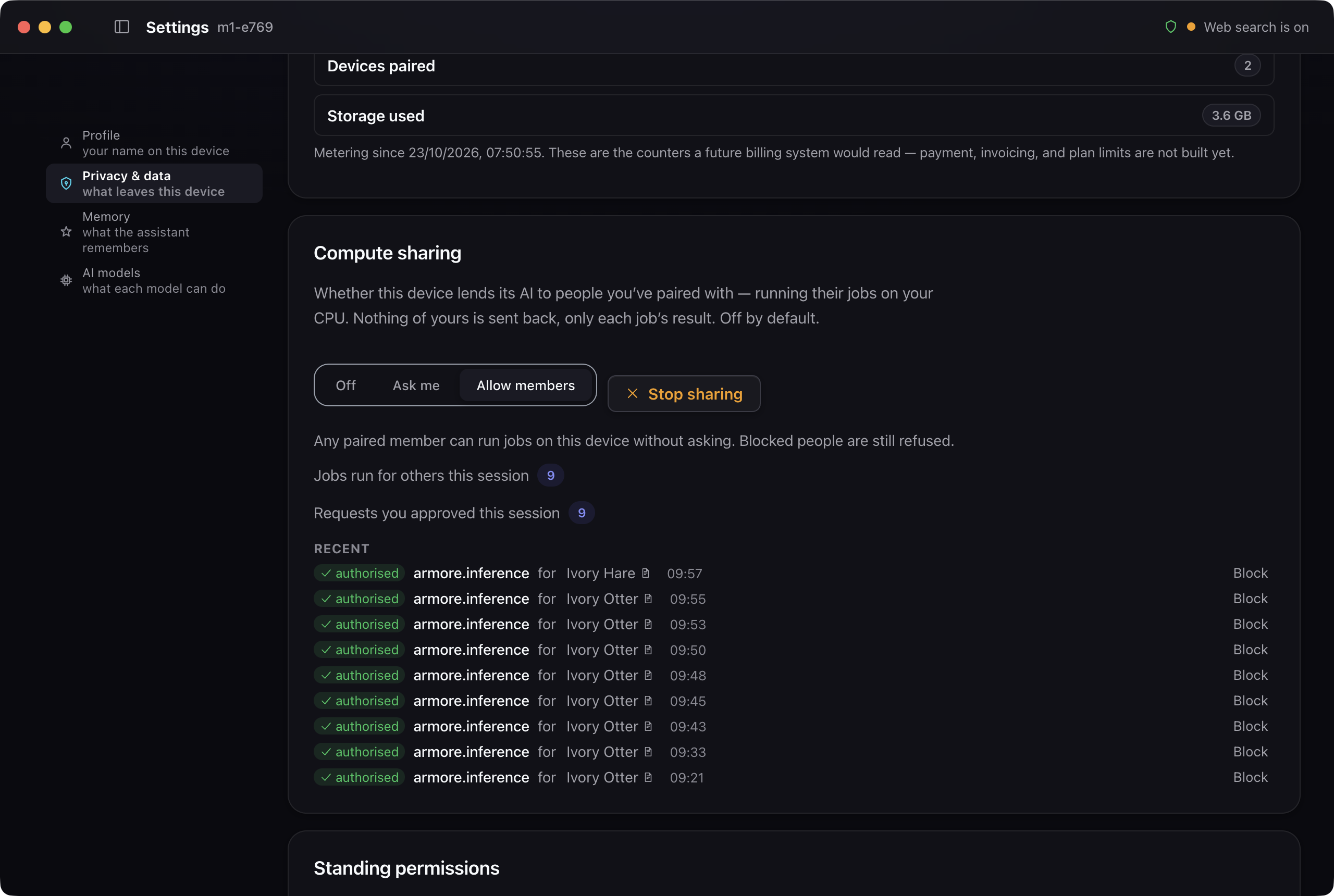
On the machine with the model, open Settings → Privacy & data → Compute sharing and choose Allow members. The same panel offers Stop sharing, and it is the only switch involved; there is no standing grant to forget about.
Ask from the other machine
Nothing changes on the asking side. Ask as you normally would; if that machine has no model of its own, the work goes to the paired machine that does and the answer comes back. The serving machine's counters go up and the job appears in its recent list.
A machine works out whether a model will actually fit in the memory it has free, not in the memory it has in total. A laptop that cannot really run one no longer tries to download it when a paired machine can answer instead.
What this does not do yet
We have run this between two machines. With more than two paired and able to serve, we are not yet confident the right one answers every time, so treat a larger set as early rather than finished. The recent-jobs list also labels every row authorised, including rows that ran to completion; if your two counters ever disagree, that list will not tell you which rows did the work.
This is your own machines helping each other. A person you work with can join the same workspace with a key and ask questions against it: they get answers, never your files.
What crosses, and what is refused
One run, two halves
When part of a job is answerable here and part needs the tier you pointed it at, Armore runs both and then tells you which half ran where. Two halves that ran in the same place is not a split, however it was planned, and is not reported as one.
If a half came back from a host it could not verify, the run reads unverifiable — not local. Armore will not tell you your data stayed on your device unless it can prove it did, because saying so is a positive claim and an unprovable dispatch has not earned it.
When a half is refused, whose limit was it?
Every refusal names an actor. These are the exact words the card shows you.
| Reason | What the card says | Whose |
|---|---|---|
| cloud-not-provisioned | No provider was connected | Operator |
| cloud-grade-unproven | The provider never proved it was good enough | Operator |
| cloud-allowance-exhausted | Your cloud allowance is spent | You |
| cloud-spend-cap-reached | We hit our own spending ceiling | Ours |
| consent-absent | You had not allowed this job to leave the device | You |
| consent-revoked-mid-job | You withdrew permission while this was running | You |
| timed-out | The cloud half ran out of time | You |
| dispatch-failed | That half never started | Nobody |
| empty-local-generation | The on-device model returned nothing | Nobody |
Two of those blame nobody, deliberately. dispatch-failed adds "It failed before anything was sent. Nothing left the device for it" — a claim about your data staying put that it is entitled to make, because the half never left. empty-local-generation adds "Not a refusal and not an answer": the model on your machine produced no text, which is a third thing and is reported as one.